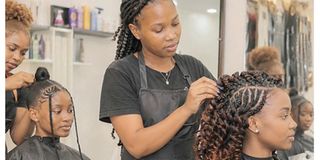
Dar es Salaam. Tanzania’s hairdressers, barbers, make-up artists and nail technicians are seeking greater recognition and a stronger role in the country’s economy as they position themselves to benefit from the rapidly expanding global beauty and personal care industry, currently valued at $590 billion.
Long viewed as ordinary service providers, beauty professionals in Tanzania are increasingly pushing for recognition as contributors to the country's creative economy, arguing that their work extends beyond aesthetics to include entrepreneurship, employment creation and artistic innovation.
The sector’s renewed momentum comes as the government moves to formally recognise and organise practitioners through the launch of the Tanzania Hairdressers and Cosmetologists Association (CCT), a step expected to raise the profile of the profession and create new economic opportunities.
Globally, the beauty and personal care industry continues to grow steadily.
According to a June 2026 analysis by McKinsey, the market is expanding at an annual rate of fi ve percent and is projected to reach $700 billion by 2032, with skincare products and artificial intelligence-driven personalised beauty solutions expected to drive demand.
Stakeholders say Tanzania should position itself to claim a share of this expanding market. For many years, however, practitioners in the local beauty industry have had to contend with perceptions that the profession is a last resort for those unable to secure opportunities elsewhere.
Industry players argue that such attitudes have denied them the recognition accorded to other creative professions despite the sector supporting thousands of livelihoods across the country.
Speaking during a recent meeting with hairdressers, Minister for Information, Culture, Arts and Sports Paul Makonda said the government intends to change that narrative by introducing measures aimed at strengthening and formalising the industry. "This profession should not be looked down upon.
Your work combines creativity and economic contribution, and the government will soon recognise you officially," said Mr Makonda. He said the government plans to register salons and beauty professionals and issue them with offi cial identifi cation cards, a move expected to improve their visibility and create systems for safeguarding their rights and working conditions.
Authorities are also considering ways of helping salon owners access fi nancing to enable them to purchase equipment and improve productivity. Mr Makonda said the beauty industry could play an important role as Tanzania prepares to host major international events, including the 2027 Africa Cup of Nations (Afcon) and the Miss World Festival scheduled for next year.
"This sector will make a huge contribution during these major events. We also want hairdressers and beauty professionals to learn foreign languages so they can serve international visitors more effectively," he said.
The chairperson of CCT, Ntuli Mwakatobe, said the beauty industry has signifi cant potential to support Tanzania's growing creative economy while creating employment opportunities for young people. "This is an art just like any other. It can create employment opportunities for many young people and contribute greatly to economic growth," she said.
According to her, the industry also supports performers, models and public fi gures by helping them build and maintain their professional image. "Society should view this profession as part of development and not merely as a service," she added. The Acting Assistant Director for Technical Arts at the National Arts Council (Basata), Bona Masenge, said the industry has increasingly become an important source of employment and income, particularly for women and young people. "The development of the beauty and grooming sector is important because it contributes to the national economy and creates jobs. It also nurtures talent and promotes Tanzania internationally," she said.
Ms Masenge urged the public to recognise beauty professionals as creative practitioners whose work demands technical expertise and artistic ability. Meanwhile, the association's patron, Jokate Mwegelo, called for the establishment of a national beauty and grooming festival that would allow local professionals and producers to showcase their skills and products.
Despite growing recognition, industry players say challenges remain, including limited access to capital and inadequate opportunities for professional development. Nail technician Jumanne Shukuru said public perception remains one of the biggest barriers facing practitioners. "It is time for society to see us as part of the creative economy and not as people who had nothing else to do," he said.
He said beauty professionals undergo training and should receive the same respect and recognition accorded to other professions
Register to begin your journey to our premium contentSubscribe for full access to premium content