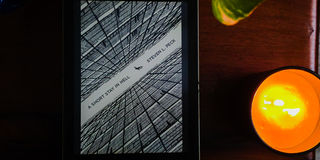
A Short Stay in Hell begins with Soren Johansson, a man who dies expecting heaven but wakes up in hell, convinced a mistake has been made. In his mind, he was supposed to be dancing with angels, not sitting across from a demon.
We spend so much of our lives building certainty. Certainty about God. About ourselves. About the people we love. About what happens after we die. But what happens when certainty disappears?
Stephen L. Peck's A Short Stay in Hell begins with Soren Johansson, a man who dies expecting heaven but wakes up in hell, convinced a mistake has been made. In his mind, he was supposed to be dancing with angels, not sitting across from a demon.
"What? I'm telling you, I was a Christian. I read the Bible every day. I donated money to the TV evangelists every Sunday. And I was saved."
His disbelief made me wonder what I would do if I discovered that something I had believed my entire life to be true was wrong, not only about God, but also about myself, other people, and right and wrong.
I am a Christian, so I could not read this part without placing myself in Johansson's shoes. I kept asking myself what I would do if I found myself where he was, convinced that there had been a mistake. I still believe in God. I still believe in His love. But I found it remarkable that a fictional story made me reflect on something I rarely consider.
But this book asks a much bigger question than whether Johansson believed in the wrong God.
Hell, in Peck's imagination, is an infinite library containing every book that has ever been written and every book that could ever be written. Somewhere in those shelves is the book that tells Johansson's life exactly as it happened. The only way out is to find it.
The problem is that almost every book is meaningless. Page after page is filled with random letters and nonsense. Finding a sentence that makes sense is considered a miracle.
The more I read, the less I thought about fire and punishment. I found myself thinking instead about what endless time would do to a person.
Life in this hell has its own system. If you get hurt or die, you wake up the next day completely restored. Everything resets overnight.
My first thought was that this did not sound like hell at all. Imagine everyone who dies getting another chance the next day. Even in my simplistic way of thinking, that could ease so much suffering.
As the story unfolds, you realise that endless second chances turn out to be a different kind of hell altogether.
There is something comforting about having something to look forward to. You go to bed knowing that tomorrow holds something for you. It could be seeing someone you love, starting a project, reading another chapter, or having coffee with a friend. Anticipation gives us a reason to welcome tomorrow.
In this version of hell, that slowly disappears. Everything eventually loses its meaning. When you have all the time in the world, tomorrow stops feeling different from today. There is nothing new to hope for because there is always another tomorrow.
I realised how much of life is held together by anticipation, and how easily we take it for granted because we assume it will always be there.
"Anticipation is a gift. Perhaps there is none greater. Anticipation is borne of hope," Johansson thinks as he longs to see the woman he loves again, even though he knows the chances of finding her are almost nonexistent.
What fascinated me most were the people in this hell. Even after death, they still ask one another what they did when they were alive and how they died. It seems we cling to our identities even when the lives that created them are long gone.
That made me ask myself a question I have asked myself too many times. Who am I without my job? Without being someone's daughter, sister, aunt or friend? Without the roles that organise my days?
The people Johansson meets are overwhelmingly white Americans who speak the same language and share the same cultural references. For someone who finds joy in books from different countries, travelling to unfamiliar places and listening to other people's stories, that sameness felt like another punishment altogether.
When I closed the book, I realised it had shifted the question I began with. I no longer wondered whether everything I do will matter forever. Instead, I wondered whether life is meaningful precisely because it does not last forever. Perhaps our days matter because they end. Perhaps love matters because it is temporary. Perhaps kindness matters because every opportunity to offer it eventually runs out.
I am still not sure what happens after this life. But I left A Short Stay in Hell more determined to live this one well.
Jane Shussa is a digital communication specialist with a love for books, coffee, nature, and travel. She can be reached at [email protected].