Across Africa, universities produce thousands of research papers every year. Yet a persistent challenge remains: the limited translation of research into products, services, policies, and technologies that directly improve people’s lives.
When Singapore gained independence in 1965, it faced a daunting reality. It was a tiny island nation with no significant mineral deposits, limited land, scarce natural resources, and widespread unemployment.
Today, Singapore ranks among the world's most advanced economies, a global financial hub, and one of the leading centres for innovation, technology, and research.
Its transformation did not happen by chance. It was built through deliberate investments in education, research, skills development, innovation, and strong institutions.
That message resonated strongly at the University of Dar es Salaam (UDSM) during the 11th Research and Innovation Week, where Singapore President Tharman Shanmugaratnam challenged African countries to place people, knowledge, and innovation at the centre of their development agendas.
Delivering a public lecture titled "Investing in the Drivers of Inclusive Growth", President Tharman argued that the prosperity of nations depends less on natural resources and more on human capabilities.
"A nation's true wealth lies not in its natural resources, but in the capabilities, aspirations and unity of its people," he told an audience of government officials, diplomats, academics, students and private-sector leaders.
His remarks came at a time when Tanzania is increasingly seeking to position itself within the global knowledge economy while pursuing industrialisation, digital transformation, and value addition across key sectors.
For many participants attending the three-day Research and Innovation Week, the Singaporean leader's message served as a powerful reminder that research and innovation are no longer optional components of development. They are becoming the foundation upon which future competitiveness will be built.
The missing link between research and development
Across Africa, universities produce thousands of research papers every year. Yet a persistent challenge remains: the limited translation of research into products, services, policies, and technologies that directly improve people’s lives.
This gap between knowledge creation and practical application featured prominently in discussions throughout the UDSM event.
Representing the Permanent Secretary in the Ministry of Education, Science and Technology, Prof Carolyne Nombo, the Tanzania Commission for Science and Technology (Costech), Director General, Dr Amos Nungu, closed the conference with a strong emphasis on the importance of a knowledge-driven economy.
He noted that Tanzania's long-term development goals require an education system capable of producing innovators, researchers, and problem-solvers.
"The vision 2050 cannot be achieved without an education system that produces people with skills, values, innovative thinking, and the ability to utilise technology," he said.
He further stressed that research conducted in universities should not remain on library shelves.
"It is important that research and innovations produced at universities reach communities and productive sectors."
This challenge is not unique to Tanzania. According to Unesco, many developing countries continue to struggle with weak links between universities, industry, and policymakers, limiting the practical impact of research findings.
Unesco argues that countries achieve the greatest development gains when scientific discoveries are successfully commercialised, integrated into industries, and used to inform public policy.
Lessons from Singapore
Singapore's development story offers one of the clearest examples of how research and innovation can transform a nation.
Over the past six decades, the country has systematically invested in science, engineering, technical education, and research institutions. Today, Singapore spends billions of dollars annually on research and development, while its universities consistently rank among the world's best.
Its innovation ecosystem continues to attract leading global companies, reinforcing its position as a knowledge-based economy.
President Tharman said Africa stands at a historic turning point.
With nearly 500 million young people expected to enter the workforce within the next decade, he described job creation as the continent's most urgent challenge.
"Good jobs must be the test of whether development is succeeding," he said.
The Singaporean leader challenged governments to focus not only on academic qualifications but also on practical skills and lifelong learning.
"What matters most is not certificates, but capabilities," he emphasised.
For Tanzania, this message aligns closely with ongoing debates around graduate employability, industrial skills, and the need to strengthen Technical and Vocational Education and Training.
Education experts argue that future economic success will increasingly depend on the ability of countries to continuously upgrade skills in response to technological change.
UDSM's growing research footprint
If Tanzania is to become a knowledge-driven economy, universities will play a central role. Few institutions illustrate this better than the University of Dar es Salaam.
Over the years, UDSM research has contributed to public policy reforms, industrial development, environmental management, education improvement, and technological innovation.
According to the Deputy Vice Chancellor for Research, Prof Nelson Boniface, the annual Research and Innovation Week has become an important platform for showcasing the country's scientific talent.
"These celebrations have contributed to promoting our researchers, innovators, and scholars, attracting their participation in major strategic national and international projects because of the quality of their work," he said.
The results are increasingly visible. The university's contribution to high-quality scholarly publications has reached 16.1 percent, nearly four times the global average.
Innovation is also gaining momentum. Within the past ten months alone, UDSM researchers registered six patents, reflecting growing awareness about intellectual property protection and the commercial potential of research.
Beyond academic achievements, research is beginning to generate economic opportunities. Data presented during the event showed that 19 percent of Tanzania's start-up businesses have been established by UDSM graduates.
Many observers view this as evidence that universities are increasingly becoming engines of entrepreneurship and job creation.
Why investment matters
Globally, countries that invest heavily in research and development tend to enjoy higher productivity, stronger industrial growth, and greater competitiveness.
World Bank data from 2025 shows that advanced economies typically invest between two and five percent of GDP in research and development.
In contrast, many African countries spend less than one percent.
The late Kenyan scholar and one of Africa's most influential voices on innovation, Prof Calestous Juma, repeatedly argued that universities must become active participants in economic development rather than remaining isolated centres of learning.
According to him, successful economies emerge when education, research, entrepreneurship, and industry work together.
His argument remains highly relevant for Tanzania. As the country seeks to improve further in all spheres, research institutions have an opportunity to provide the evidence, technologies, and innovations needed to support those ambitions.
From laboratories to markets
One recurring theme throughout the conference was the need to move research beyond laboratories and academic journals.
The challenge is not producing research.
The challenge is ensuring that discoveries reach the market.
According to the Organisation for Economic Co-operation and Development (OECD), countries with strong university-industry partnerships are more successful in commercialising innovations and creating high-value jobs.
This partly explains why collaboration featured prominently during the UDSM event.
Researchers, mining companies, financial institutions, government agencies, and technology firms gathered to discuss how innovations can be transformed into commercial products and services.
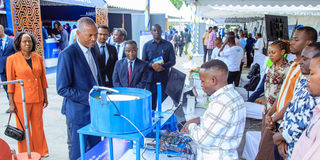
Examples were already visible throughout the exhibition halls. Students showcased technologies designed to address challenges in agriculture, energy, healthcare, and digital services. Entrepreneurs demonstrated how university knowledge can be converted into viable businesses. Industry players explored opportunities for collaboration with researchers.
The global economy is changing rapidly. Experts argued that artificial intelligence, renewable energy, biotechnology, and advanced manufacturing are reshaping industries worldwide.
President Tharman observed that while technological change may eliminate some jobs, it will also create entirely new opportunities for entrepreneurship and productivity growth. Countries that invest in skills and innovation today will be best positioned to benefit tomorrow.
For Tanzania, the opportunity is significant. The country possesses abundant natural resources, a growing population, expanding digital connectivity, and a youthful workforce.
However, experts warn that resources alone will not guarantee prosperity. What matters is how effectively the country generates knowledge, develops technology, and converts ideas into economic value.