Beyond Campus: Tanzanian graduates face harsh job market realities
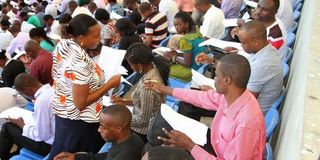
University students sit for an academic session. As more Tanzanians graduate each year, competition for employment opportunities continues to grow. PHOTO | COURTESY
Dar es Salaam. After several years of studying and building hopes for a new life, thousands of students from various universities across the country are officially commencing their journey of leaving campus and entering the next phase of life.
According to calendars of various universities, final examinations began last week, with final-year students preparing to return to civilian life to encounter the reality of life outside university premises.
Many carry hopes of securing employment, becoming self-reliant, and applying their acquired professions, yet they face a job market with far greater competition than anticipated.
Government statistics through the National Bureau of Statistics (NBS) show the unemployment rate dropped from 8.9 percent in 2023 to 6.2 percent in 2024.
However, over 90 percent of employment nationwide remains in the informal sector, a situation indicating that income-generating opportunities exist, though not all are formal jobs expected by graduates upon finishing studies.
After graduating, some youths enter small businesses like informal street hawking (machinga), brokering, various product entrepreneurship, or other commercial activities to generate income whilst awaiting formal employment.
Others choose to venture into agriculture or start production activities, particularly in rural areas, whilst others find themselves performing jobs they previously never contemplated, including driving motorcycle taxis (boda boda).
An example is Mr James Ndoni, a St Augustine University of Tanzania (SAUT) graduate from Mwanza, from 2020, who, after completing studies, entered motorcycle taxi driving for over three years due to a lack of employment matching his teaching profession.
He says after graduating, he attempted to seek various employment opportunities, but owing to intense competition in the job market, he was forced to seek alternative means to earn an income.
“I completed my studies with hopes of securing employment related to my profession, but the employment situation forced me to make another decision. Driving a motorcycle taxi helped me sustain life whilst continuing to search for other opportunities,” says Mr Ndoni.
Some graduates enter sports betting, hoping to generate quick income due to the difficulty of obtaining employment or capital to launch businesses.
However, this situation has been generating debate regarding how some youths seek alternative ways to survive after completing studies.
For another group, some remain dependent on parents, guardians, or relatives whilst awaiting employment opportunities in government or the private sector.
Others stay in the streets and at local hangouts, waiting for news about job hustles, training, or other opportunities.
Under such circumstances, some graduates encounter challenges from employment network agents who exploit this situation to target them by promising connections to employers through various network groups, whilst demanding registration payments or service fees.
What is happening within families?
For family members funding education, the employment challenge for graduates also increases burdens on parents who invested money, time, and effort to ensure their children receive higher education.
A parent from Tabora Region, Ms Rehema Mashishanga, says after her daughter completed final examinations this month, her primary expectation is seeing her secure employment and begin benefiting from the education received.
“We endured much to ensure the child reached here. Now my hope is seeing her secure employment so the burden of maintaining her reduces and we parents begin seeing the benefits of her education,” she says.
This situation demonstrates that the journey of graduates after university varies.
Some secure formal employment, others employ themselves, others enter the informal sector, whilst others wait long periods for opportunities to utilise their education.
What they encounter in civilian life
A St Augustine University of Tanzania (SAUT) graduate, Mwanza, 2020, Enock Bulai, says his hopes whilst studying transformed after entering the streets, as conditions encountered differed from his expectations.
He says he believed that after finishing university he would hold a better position to secure employment due to his education, but that situation failed to materialise for all these years until now, forcing him to seek alternative ways of living without applying his profession.
“The problem when finishing university is you become an adult; you cannot call mum asking for mobile airtime. Furthermore, you consider yourself educated, selecting jobs to perform. Encountering street hardship, a time comes when you set your profession aside, doing any work to earn income,” he says.
Mr Bulai advises youths completing university studies to enter civilian life prepared to face different environments and ready to undertake various jobs whilst seeking opportunities matching their professions.
“Since completing university studies six years ago, I have never been employed anywhere. I have submitted certificates to various places, ending up being told ‘not selected for oral interview’. I continue struggling on the streets. I have done various jobs, including agriculture, mining, and trade,” he explains.
Expectations of graduates
Despite those challenges, many graduates still hold hopes of using their education to build better lives and achieve self-reliance.
A Computer Science student at the University of Dar es Salaam (UDSM), Mr Arafati Alli, says he wishes to see his education help him enter the job market, achieve self-reliance, and assist his family.
“My expectation after completing university studies is securing a position permitting me to use my computer skills. When I start earning a salary, I will have the capacity to establish myself and assist my parents,” says Mr Alli.
On his part, Mr Yasir Urasa, graduating with a Journalism Degree at the School of Journalism and Mass Communication (SJMC) of the University of Dar es Salaam (UDSM), says he wishes to secure employment matching his profession to begin building a self-reliant life.
“My expectations after completing my studies at the university are securing employment that aligns with what I studied,” he says.
Graduating with an Education Degree at the UDSM, Mr Hamis Bakari says he expects to start by securing any teaching post to build experience, whilst planning later to establish a school supplies business and advance professionally.
“I want first to secure any teaching post to gain an opportunity to practise my profession, then I will advance myself as I obtain further opportunities,” he says.
On the other hand, Ms Monica Lukanda believes the post-university journey requires patience, learning, and adding skills rather than relying solely on a certificate.
“At university you learn theory, but on the street you learn life. A certificate opens the door for you, but discipline, skills, and patience are what will take you far,” she says.
Unlike her colleagues who aim to be employed, Ms Asha Mohamed says she has directed her energy into content creation, social activities, and agriculture, believing self-employment can offer a route to create opportunities for others.
“I created something aimed at assisting youths possessing ideas and dreams who lacked people to hold their hand,” she says.
Government efforts
In addressing this challenge, the government continues implementing various strategies, with President Samia Suluhu Hassan emphasising that the youth employment problem cannot be solved by the government alone.
She says the solution requires investment, strengthening the private sector, promoting skills, and building youth capacity for self-employment through entrepreneurship and innovation.
This emphasis aligns with the CCM election manifesto promise to continue improving the investment environment, expanding employment opportunities, and enabling youths to participate in productive activities.
Furthermore, the government continues placing emphasis on skills education and improving the Vocational Education and Training Authority (Veta) system to build graduates' capacity for self-employment.
Despite those efforts, many graduates entering civilian life still face intense job competition, with some forced to undertake work unrelated to their professions to support themselves.
Others stay months or even several years without securing formal employment, a situation making them continue depending on families longer than anticipated.
Likewise, although some employers offer opportunities to fresh graduates, many employers now do not consider certificates alone, but also look at work experience, additional skills, and problem-solving capabilities.
Stakeholders highlight solutions
Whilst the debate regarding university graduates' employment challenge continues nationwide, scholars recommend collaboration between government, the private sector, and citizens in building an economy capable of generating employment.
Sokoine University of Agriculture (SUA) Vice-Chancellor, Prof Raphael Chibunda, says the employment challenge for graduates is not a Tanzanian issue alone, but confronts many developing countries.
He says the solution ought to look jointly at the quality of education provided and the economy's capacity to absorb produced professionals.
“I was at a meeting in Nigeria discussing this matter. Someone asked, if we brought 2,000 graduates today from MIT, Stanford, or Oxford here to Tanzania, would all secure employment? There was no direct answer. That is where we discovered that alongside improving curricula, we must also build an economy generating employment,” he says.
He says universities hold a responsibility to produce graduates possessing knowledge and skills, but cannot serve as employers; thus the nation ought to build industries and technology sectors requiring those professionals.
For his part, the UDSM Deputy Vice-Chancellor, Prof Nelson Boniface, speaking during the institution's 11th research commemorations in June this year, said that step demonstrated success in enabling graduates to become economically self-reliant.
“Through research and skills, many of our graduates managed to employ themselves, and over 800 applied for loans at financial institutions based on businesses they operate,” he said, adding that this could prove a solution to the graduate employment problem nationwide.
Economics lecturer Malcom Lambert says Tanzania has been investing in increasing graduate numbers, but growth in sectors capable of employing them has not matched that pace.
“You can produce many graduates possessing good skills, but if the economy lacks industries, technology companies, research institutions, and sectors requiring that expertise, the employment challenge will persist,” he says.
An education policy expert, Mr Patricl Msuya, says education can prepare a person to be better, but cannot create employment without an environment of investment and growth across various sectors.
A community development expert, Ms Hadija Mbando, says the country needs to connect technical skills with higher education knowledge to build a competitive economy.
“We cannot be a nation of technicians alone, nor a nation of scholars alone. We require a system connecting technical skills and higher knowledge to build a competitive economy,” she says.
Register to begin your journey to our premium contentSubscribe for full access to premium content