How education officers, head teachers hinder provision of inclusive education
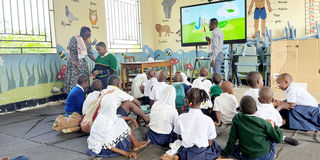
Pupils with special needs in the Special Education Unit at Nianjema Primary School in Bagamoyo District during a lesson using video-based learning. PHOTO | ELIZABETH EDWARD
Dar es Salaam. While shortages of teachers and assistive devices have been identified among the challenges hampering inclusive education, a government study has also implicated special education officers and head teachers as part of the problem.
An investigation by The Citizen’s sister publication, Mwananchi, in selected schools in Bagamoyo District, Coast Region and Kilombero District in Morogoro Region has found that children with special needs face numerous challenges that prevent them from accessing education on an equal basis.
Among these are a lack of assistive devices such as mobility aids, physiotherapy equipment, Braille books and hearing devices, all of which continue to hinder the delivery of inclusive education.
Speaking to Mwananchi, the Director of Special Education at the Ministry of Education, Dr Magreth Matonya, said the government had continued investing in children with special needs to ensure they were not left behind in the education system.
However, she acknowledged that several challenges still undermine these efforts, including the failure of some special education officers to perform their duties effectively.
She said an assessment conducted by the government found that some special education officers had not fulfilled their responsibilities to the required standard and that measures were already being taken to address the issue.
“Some identify children with special needs but do not follow up on their progress after they enrol in school.
Others fail to coordinate communication between pre-primary schools and the schools children join after completing their studies, which may affect continuity in learning,” she said.
“We conducted an assessment in collaboration with Tamisemi and identified gaps. In July we will meet with these officers to provide guidance and instructions based on findings from the analysis of the implementation of inclusive education at primary school level.”
Dr Matonya said quality assurance officers had been closely monitoring classroom teaching and providing feedback aimed at improving education delivery for learners with special needs.
“Through quality assurance officers we follow up on the reasons why some children drop out of school. If a child says they do not have mobility support, we look for ways to provide it.
If transport is the challenge, we work with parents and in some cases facilitate accommodation in boarding facilities so that the child can continue with studies,” she said.
Shortage of assistive devices
Regarding the lack of assistive devices, Dr Matonya said the problem was partly caused by head teachers and special education officers failing to fulfil their responsibilities.
“We rely on information from head teachers and special education officers because they know how many children with special needs are in their areas and what equipment is required.
Once they submit the information, we supply the devices. There has been a lack of accountability and this is causing delays; we have identified the problem and are addressing it,” she said.
She added that once a learner had been identified, the required equipment should be procured, even if the needs were identified after the official assessment period.
“The ministry has a budget for purchasing equipment. The issue is that schools have not submitted the necessary information; this is not a government problem.”
She said the government had distributed assistive devices worth Sh10 billion nationwide and maintained reserve stock.
“If I receive information on the need for devices such as mobility aids or hearing equipment, I know where they can be sourced because some schools receive larger quantities and store them,” she said.
On identification of children with special needs, she explained that the process runs from October to March, during which assessment teams move through neighbourhood and village clusters to identify children requiring support.
However, she admitted that not every council had an assessment centre and that such facilities currently existed mainly at regional level, making access difficult for many people.
To address this challenge, she said plans had been introduced for outreach teams to visit communities at the ten-household level and facilitate referrals for children requiring assessment.
“This team, comprising teachers specialising in five categories of disability, quality assurance officers, social welfare officers, doctors and special education officers, visits local community leaders who identify children with disabilities.
The team then assesses the child, determines educational or medical needs, registers them and begins monitoring their progress,” she said.
Teacher shortage
On shortages of special education teachers, Dr Matonya said the government had introduced measures to strengthen the availability of teachers with expertise in inclusive education.
She said that previously only Patandi Teachers’ College produced special education graduates, with around 200 teachers graduating annually, but the programme had since been expanded to Kabanga and Mpwapwa colleges, increasing the number of graduates to more than 1,000 per year.
Inclusive education and sign language had also been made compulsory subjects for all trainee teachers at different levels of teacher education to ensure all graduates acquire basic skills for supporting learners with special needs.
“Starting next year, every graduating teacher will have basic knowledge and skills to support children facing various challenges,” she said.
For teachers already in service without specialised training, she said the government continued to provide capacity-building programmes funded by different projects.
“We have also introduced sign language clubs in schools that help teachers and students learn and teach one another,” she added.
Inclusive education is currently being implemented under the National Inclusive Education Strategy (2022–2026). The approach is also supported by the Persons with Disabilities Act of 2010, particularly Sections 27 and 28, which require educational institutions to ensure equal access to education and create disability-friendly learning environments free from discrimination.
Section 27(4) requires schools to provide specialised support services for learners with disabilities, including special education teachers, learning materials and alternative communication methods.
To be continued tomorrow with stakeholders’ recommendations on improving implementation of the inclusive education strategy
Register to begin your journey to our premium contentSubscribe for full access to premium content