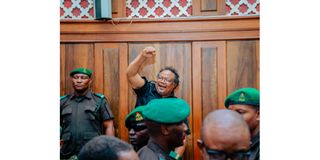
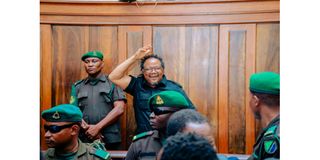
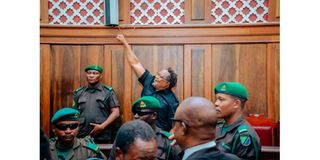
Dar es Salaam. Chadema chairman Tundu Lissu has lodged a preliminary objection at the Court of Appeal, challenging the State’s attempt to review a High Court ruling that barred prosecutors from introducing additional evidence in his treason case.
Lissu argues that the Republic’s application lacks legal basis because it seeks to challenge a decision that is neither appealable nor subject to review.
The matter came up on Friday, July 3, 2026, before a three-judge bench of the Court of Appeal comprising Justice Augustine Mwarija, Justice Zainabu Muruke and Justice Amour Khamis, with Justice Mwarija presiding.
The court directed that both Lissu’s preliminary objection and the Republic’s substantive application be heard together, beginning with the objection before any consideration of the merits of the application.
The Republic filed the application on February 24, 2026, seeking to challenge a High Court decision delivered at the Dar es Salaam Sub-Registry, which rejected its request to adduce additional evidence in the treason proceedings against Lissu.
In his objection, Lissu argues that the State is attempting to challenge an interlocutory ruling that did not conclusively determine the rights of the parties and therefore falls outside the jurisdiction of the Court of Appeal.
He contends that established legal principles provide that only decisions which finally determine the rights of parties may be appealed or reviewed.
According to Lissu, the High Court ruling in question merely rejected an application to introduce additional evidence while the substantive treason case remains pending.
He further argues that the State’s application itself demonstrates dissatisfaction with the refusal to admit further evidence rather than a final determination of the proceedings.
Lissu also maintains that the State lacks legal authority to seek review of procedural rulings under the circumstances presented before the court.
The dispute stems from a High Court ruling issued on February 24, 2026, after the prosecution sought permission under Section 308(1) of the Criminal Procedure Act (CPA) to introduce additional evidence.
Senior State Attorney Nassoro Katuga told the court that the prosecution had filed a notice on February 18, 2026, seeking to adduce additional evidence from Assistant Commissioner of Police (ACP) Amin Mahamba.
The prosecution said the evidence had not been tendered during committal proceedings conducted at Kisutu Resident Magistrate’s Court.
Katuga further submitted that ACP Mahamba had led the investigative team during the October 2025 General Election and that the additional material was identified during witness preparations.
Lissu opposed the application, arguing that Section 308(1) of the CPA applies only to evidence that existed during committal proceedings but had not been tendered, and not to evidence discovered afterwards.
He argued that ACP Mahamba had already testified during the committal stage and that introducing new material through the same witness would effectively alter the basis of the case.
In his ruling, High Court Judge Dunstan Ndunguru agreed with Lissu, holding that Section 308 permits admission only of evidence that existed during committal proceedings but was not presented at the time.
Justice Ndunguru found that the State sought to introduce material obtained after the committal process and outside the legal scope provided by the law.
The High Court subsequently dismissed the application, prompting the State to seek a review before the Court of Appeal.
Lissu faces one count of treason under Section 39(2)(d) of the Penal Code over allegations that he made statements suggesting an intention to obstruct the conduct of the 2025 General Election.
Register to begin your journey to our premium contentSubscribe for full access to premium content