Tazara revival to boost freight capacity, ease pressure on roads
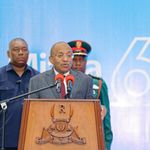
Temeke District Commissioner Sixtus Mapunda speaks during the launch of activities marking the 50th anniversary of the Tanzania–Zambia Railway Authority (Tazara) at the authority’s head office premises in Dar es Salaam on Tuesday, June 30, 2026. PHOTO | RAMADHANI ISMAIL
Dar es Salaam. The planned revitalisation of the Tanzania–Zambia Railway Authority (Tazara) is expected to significantly boost freight capacity, improve service reliability and operational efficiency, while shifting more cargo from road to rail to ease pressure on highways, reduce maintenance costs, enhance road safety, and cut carbon emissions.
The assurances were made yesterday during the launch of activities marking the authority’s Golden Jubilee, where government and railway officials outlined how the multi-billion-dollar rehabilitation programme is expected to reposition the railway as a key transport and logistics corridor for Tanzania and the wider region.
Speaking at the event, Temeke District Commissioner, Mr Sixtus Mapunda, described the rehabilitation of Tazara as a strategic investment that will strengthen the country’s transport network while improving efficiency at the Port of Dar es Salaam.
“A modern and efficient Tazara will significantly improve freight capacity, service reliability, and operational efficiency,” he said.
Mr Mapunda said about half of the cargo transported through Tazara consists of transit goods destined for neighbouring countries, while the remaining 50 percent serves the domestic market.
“Of the cargo used within Tanzania, only 10 percent is transported outside Dar es Salaam. The remaining 90 percent is handled within Dar es Salaam, and of that, 67 percent is concentrated in Temeke District,” he said.
According to him, between 65 and 70 percent of transit cargo handled through the Port of Dar es Salaam has the potential to be transported via the Tazara corridor, making the railway critical to improving port efficiency and competitiveness.
“The rehabilitation of Tazara is therefore a strategic and fundamental decision that will enable the Port of Dar es Salaam to provide world-class services,” he said.
The governments of Tanzania and Zambia jointly spearhead the rehabilitation programme under a public-private partnership (PPP) arrangement.
Tazara Managing Director, Mr Bruno Chinga’ndu, said the initiative aims to transform the railway into a modern, efficient, and competitive transport and logistics corridor capable of meeting growing regional demand.
“We have entered into a PPP concession agreement with China Civil Engineering Construction Corporation (CCECC), an experienced international contractor that has built railways in several African countries, including Ethiopia and Nigeria,” he said.
He said strategic investment in infrastructure, rolling stock, and operational systems would lay the foundation for increased freight capacity, improved customer service, and greater operational efficiency.
Beyond railway operations, Mr Chinga’ndu said the project is expected to unlock broader economic opportunities by attracting investment along the railway corridor.
“The revitalisation is about unlocking economic opportunities and stimulating investment in sectors such as mining, agriculture, manufacturing, logistics, and tourism. We envision Tazara becoming a catalyst for industrial and economic transformation in the region,” he said.
Providing further details, Tazara Regional Manager, Mr Fuwad Abdallah, said the $1.4 billion rehabilitation project, whose concession agreement was signed on September 29 last year, is designed to address ageing infrastructure, shortages of rolling stock, inadequate technical expertise, competition from road transport and other regional corridors, as well as rising operational costs.
Once completed, he said, the project will increase train speeds to between 60 and 80 kilometres per hour, reduce cargo transit time to between five and seven days, and lower freight transport costs.
“The project will make rail transport more efficient and competitive while strengthening regional trade and logistics,” he said.
Register to begin your journey to our premium contentSubscribe for full access to premium content