Zanzibar lawmakers debate Sh8.5 trillion budget, pushing for wider tax base
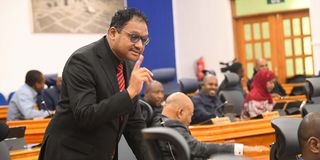
Mtoni Representative Hussein Ibrahim Makungu contributes to the debate on the Sh8.5 trillion main government budget on Monday, June 15, 2026, during a House of Representatives session at Chukwani, Unguja, in Zanzibar. PHOTO | JESSE MIKOFU
Unguja. Members of the House of Representatives have said that for the government budget to be implemented without reliance on donors, there is a need to increase domestic revenue collection through efficient systems, while ensuring economic growth reflects the real living conditions of citizens.
They made the remarks on June 15, 2026, while contributing to the main government budget during the House of Representatives session held on Monday, June 15, 2026, at Chukwani, Unguja in Zanzibar.
For the 2026/27 financial year, the Revolutionary Government of Zanzibar plans to spend Sh8.5 trillion.
Special Seats Representative, Ms Mariam Said Khamis, CCM, said that despite significant progress in economic growth, there is still a need to further strengthen the economy so that its benefits are felt by ordinary citizens.
“The economy is growing, but we still need to accelerate growth so that it is reflected in the lives of ordinary citizens, unlike the current situation,” said Ms Khamis.
She said that to achieve this and improve revenue collection, it is important to enhance technology that would significantly reduce loopholes leading to revenue losses.
Speaking on public debt, she said that although it remains sustainable, the government must ensure borrowed funds are used strictly for intended development projects and not diverted into the hands of a few individuals.
She also stressed that economic growth requires strong private sector participation, urging the government to continue improving the business and investment environment to attract more private investment, which would in turn create jobs for young people.
Malindi Representative Abdughani Ismail Zuberi, CCM, called on the government to identify new tax sources, including introducing taxation for digital platforms.
He also urged the Zanzibar Revenue Authority (ZRA) to develop a new mobile application system to enable traders to file returns via mobile phones instead of computers or machines, arguing that current systems are costly and discourage compliance.
“Simplifying tax payment and developing mobile applications will allow people to use phones instead of computers. This will widen the tax base,” he said.
On technology, he noted that Zanzibar is still lagging behind and will struggle to achieve its development goals without greater investment in the sector.
Paje Representative, Mr Jaku Hashim Ayubu, CCM, said there are still too many taxes, which are burdening citizens, especially small and growing businesses.
He also said that if taxes at airports have been removed, then the government should also consider removing port charges for passengers, as many ordinary citizens use sea transport rather than air travel.
“The burden of taxes is too high. The government must look at this more carefully, especially for small entrepreneurs who are being held back by these charges,” he said.
Special Seats Representative, Ms Zainab Khamis Shomar, CCM, said that while the budget is well-intentioned and includes tax increases on products such as nail and hair products, it should clearly specify how much will be added to each category, as they vary widely.
She also argued that just as taxes at airports have been removed, port charges should also be abolished, noting that many citizens rely more on sea transport than air travel.
“If the aim is to reduce hardship, then we should also ease pressure on boat transport. This five percent charge should be removed just like it was done for air travel,” she said.
She added that the gender-responsive budget disbursed in the previous financial year stood at Sh22 billion out of the Sh71 billion allocated, equivalent to 38 per cent, and therefore called for greater emphasis on full implementation.
Ms Aza January Joseph, also a Special Seats Member, CCM, urged the government to reduce health inspection costs for food vendors (mama lishe) to enable them to operate safely while easing their tax burden.
Committee views
Presenting the Budget Committee’s views, Chairperson Ali Suleiman Ameir said that although the government has increased taxes on selected imported goods to protect local products and boost revenue, it should ensure these measures go hand in hand with strengthening domestic production.
He also urged the government to provide a detailed assessment showing how the measures have helped reduce imports of such goods and increase local production.
As of March 2026, Zanzibar’s public debt stood at Sh3 trillion, comprising domestic debt of Sh2.987 trillion and external debt of Sh1.4 trillion.
Overall, the debt-to-GDP ratio of Sh6.572 trillion stands at 40.63 percent.
“The committee urges the government to strengthen domestic revenue collection to reduce reliance on external loans and grants, as well as improve efficiency in revenue management,” he said.
The committee further recommended that loans be repaid on time to avoid rising interest costs and safeguard the sustainability of financial institutions.
Mr Ameir said the committee also urged the government to ensure that the growth of public debt remains aligned with repayment capacity by strengthening revenue and expenditure management, and maintaining debt sustainability within the acceptable threshold of 55 percent of GDP.
Regarding government guarantees worth Sh300 billion issued to various public institutions, the committee recommended that clear conditions and criteria be established before issuing such guarantees, including ensuring timely repayment of loans and productive use of funds.