Imagine living detached from your surroundings, so unnoticed that you begin to fade from the world and from yourself. Perhaps this is what happens when no one acknowledges you for long enough.
After reading this book, I realised the greatest tragedy may be to go through life unnoticed and unacknowledged, spending your time on this beautiful earth yet remaining invisible.
Imagine living detached from your surroundings, so unnoticed that you begin to fade from the world and from yourself. Perhaps this is what happens when no one acknowledges you for long enough.
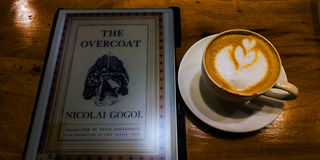
Gogol's The Overcoat introduces us to a man named Akaky. Unable to settle on one of the names presented from the church calendar, his mother simply gives him his father's name. And so he becomes Akaky Akakyevich.
I think children know what awaits them when they hear their names for the first time. It is said that children are angels, after all. If that is true, maybe they know more than we think.
"The child was christened, and during the ceremony he began to cry and pulled such a face that it really seemed as though he had a premonition that he would be titular Councillor one day."
The story begins in a government department. Gogol is careful not to tell us which one because people working in government departments have a habit of taking criticism personally, as though criticism directed at an institution is directed at them.
"To avoid all sorts of unpleasant misunderstandings, we shall refer to the department in question as a certain department."
I laughed when I read this because it felt painfully familiar.
Akaky works in this department as a copyist. He keeps to himself and bothers no one. He is constantly mocked by his colleagues, who treat him as though he has no feelings simply because he never fights back. I found myself hoping he would stand up for himself. He does, but only when the insults become physical and begin to interfere with his work.
"Leave me alone, gentlemen. Why do you pester me?"
As painful as those words were to read, they become even more heartbreaking when one of his colleagues hears something else behind them: "I am your brother."
We are all brothers and sisters. Regardless of our social standing, we share the same humanity. We all want to be treated with dignity. We all want to know that we matter.
Despite everything, Akaky loves his job. Others mock him for spending his days copying documents. To them, it is meaningless labour. To him, it is joy. Even outside the office, he copies things simply because he enjoys writing.
But joy doesn’t protect him from poverty. When his tailor tells him that his old overcoat can no longer be repaired, Akaky is devastated.
"At the word 'new' a mist suddenly spread before Akaky's eyes... How do you mean a new one?... Just mend it somehow, so that I could still use it a bit longer."
Poverty is cruel because it does more than deprive people of basic needs. It strips away dignity. Something as ordinary as a warm coat becomes impossible to find.
I recently wrote about how powerful anticipation is. Having something to look forward to is a gift. As Akaky begins saving for the overcoat, he starts imagining tomorrow differently. He sacrifices meals and comforts, but for the first time, he wakes up with hope because he knows there is something waiting for him.
"He would always come back home well satisfied, reflecting that the time was not far off when he would pay for it and when his overcoat would be ready."
Life has a cruel sense of humour.
Akaky loses his new overcoat and is advised to seek help from a "Very Important Person." Instead of compassion, he finds someone more interested in reminding others of his own importance.
"Do you realise, sir, who you are talking to?... Do you understand who is standing before you?" In our context, we all know someone whose first response is "Unajua mimi ni nani?"
After everything that follows, I found myself thinking about poverty, power, social class, and justice. I thought about legacy. I thought about belonging. I kept asking myself who gets to decide whose life matters and whose does not.
It has been a while since a book left me in tears.
The Overcoat is barely 50 pages long, yet I could not stop thinking about people who pass through this world without anyone noticing that they were here at all. I found myself wanting to tell them, ‘I know you are here. I see you, and I care about you.’
Perhaps that is why Akaky broke my heart.
We all want someone to know that we were here.
Jane Shussa is a digital communication specialist with a love for books, coffee, nature, and travel. She can be reached at [email protected].