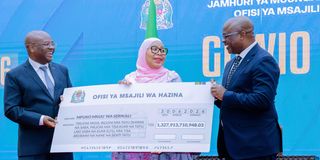
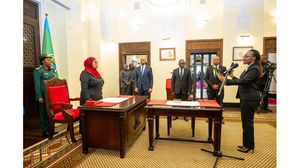
Dar es Salaam. Tanzania has taken another significant step towards economic self-reliance after public institutions and companies in which the government holds shares paid a record Sh1.327 trillion in dividends and contributions to the Treasury.
The amount, received by President Samia Suluhu Hassan during the third annual Gawio Day at State House on June 30, represents a 30 percent increase from the Sh1.028 trillion collected in the previous financial year.
Speaking during the event, President Hassan was clear that this was not merely about the figures on a dummy cheque but a reflection of a deeper structural transformation.
"This step we are witnessing and perhaps celebrating is the result of deliberate efforts to strengthen the management of corporations and companies, discipline in resource use, close monitoring, and a sincere commitment to making public assets produce more for the benefit of Tanzanians," she noted.
The Treasury Registrar, Mr Nehemiah Mchechu said since the 2020/21 financial year, collections have surged by 108 percent, rising from Sh637 billion to the current Sh1.327 trillion.
“Of this year’s total, Sh800.5 billion (60 percent) came from commercial dividends, while Sh406 billion (30 percent) was derived from the statutory 15 percent gross revenue contributions of non-commercial entities,” he explained.
The remaining 10 percent, roughly Sh121.5 billion, he said, was sourced from other investment returns.
The theme for 2026, "Public Investment with Results: A Pillar of a Competitive Economy and Sustainable Development Towards Vision 2050," underscored the weight placed on these institutions to fund the nation's self-reliance future.
"Our 2050 vision will not be completed by plans and wealth of resources alone... but it will be implemented by how those resources are managed, protected, and turned into opportunities, services, and development for the citizens," the President emphasised.
She insisted that the era of "statistics without impact" is over, demanding that institutions move from "intentions to reality".
Weighing in on this development, a Lead Economist at the Institute of Finance Management (IFM), Dr Lucas Kalinga, noted the strategic importance of Non-Tax Revenue (NTR).
"The government’s ambition to increase NTR from the current three percent to 10 percent of total revenue by 2030 is the backbone of fiscal sovereignty. By compelling public institutions to be profitable, the Treasury reduces the burden on the taxpayer and lowers the national debt ceiling."
Dr Kalinga’s assessment aligns with the President's directive for institutions to seek their own capital.
The Head of State lauded the Tanzania Ports Authority (TPA), which contributed Sh205.5 billion, for its newfound ability to borrow based on its own balance sheet rather than relying on the national treasury.
"TPA now has the capacity to be bankable... they can take a loan and pay it back, and that debt does not enter the main government debt," she remarked.
The amount paid by TPA to the government has risen by 12.4 percent compared to what the authority paid last year.
It [the Sh205.5 billion] marks an increase of Sh22.48 billion from Sh181.5 billion in 2024/25 and a 33.5 percent rise from Sh153.92 billion in 2023/24, reflecting improved performance over the past two years.
Speaking separately after the event, the TPA Director General, Mr Plasduce Mbossa attributed the growth to increased cargo throughput, operational reforms and ongoing improvements in port infrastructure and efficiency.
TPA has also involved private sector partners in selected operations through collaborations with DP World and Tanzania East Africa Gateway Terminal Limited (TEAGTL).
Highest dividend for TIPER
From the Tanzania International Petroleum Reserves Limited (TIPER) President Hassan was handed with a dummy cheque for Sh15 billion during Tuesday’s event.
The money was part of the company’s record Sh30 billion dividend paid to its two shareholders: the government and Oryx Energies.
Each shareholder holds a 50 percent stake.
TIPER Managing Director Mohamed Mohamed said separately on Tuesday, June 30, 2026 that the payout marks the highest dividend in the company’s history, driven by infrastructure investment, stronger operational management and improved utilisation of assets.
He said the results reflect a supportive investment environment under President Hassan’s administration, which has prioritised efficiency and value creation from public investments.
Mohamed said TIPER’s cumulative dividend performance has risen sharply in recent years, with the government receiving Sh30.65 billion over the past five years compared with Sh7.65 billion between 2016 and 2020.
He said the company’s income is largely derived from storage and handling services, making it less vulnerable to global oil price fluctuations.
TIPER has also expanded storage capacity from 253 million to 313 million litres following investments worth over Sh105 billion in the past decade.
The company plans to invest a further Sh265 billion over the next five years to expand infrastructure and strengthen Tanzania’s position as a regional fuel distribution hub.
The champions of 2026
Several institutions were singled out for their exceptional performance.
Twiga Minerals Corporation led the commercial pack with a massive Sh221.9 billion contribution, more than doubling its previous year's Sh93.6 billion. NMB Bank followed with Sh96.9 billion, while Airtel Tanzania provided Sh65.4 billion.
The transformation of the Tanzania Telecommunications Corporation (TTCL) was perhaps the most poignant story of the day.
After years of loss-making, TTCL turned a Sh18 billion loss in 2023/24 into a Sh22.9 billion profit for 2024/25, paying its first dividend in years of Sh1.6 billion.
Similar success was seen at the Tanzania Post Corporation, which moved from a Sh27.9 billion loss to a Sh2.8 billion profit.
The President was observed during the ceremony personally challenging CEOs. She revealed that for those who performed well, she was already "setting new targets".
"For someone who gave me 15 this year, I told them I want 20 next year. Another came with 11, I told them 15, and they told me they could reach 25," she shared, expressing her pride in the competitive spirit now taking root.
However, her message to the underperformers was stern. She referred to some institutions as having "kichefuchefu" (nausea-inducing performance) or being "chechemea" (limping).
"We cannot build a competitive economy with institutions that work by habit. We need institutions that are measured by results instead of heavy statistics that have no translation in reality," she warned.
She insisted that ministries must not only bring complaints about their parastatals but must also provide performance evaluations so the government can decide "who to prune".
A Senior Investment Analyst, in attendance, Ms Sarah Tweve, pointed to the regional implications of these reforms.
"Prof Kitila Mkumbo’s revelation that Tanzanian banks like CRDB and NMB are now ranked 3rd and 4th in East and Central Africa is a testament to the country’s economic resilience. This is about more than dividends; it is about Tanzania projecting power in the regional market."
Indeed, earlier, the minister for Planning and Investment, Prof Mkumbo, noted that for the first time, Tanzanian banks are pulling ahead of their Kenyan counterparts in major surveys, with NMB jumping in value to $1.7 billion.
The analogy of the 'Grown Child'
In a moving conclusion to her speech, President Hassan used a familial analogy to explain the duty of public institutions.
She compared an institution that refuses to pay dividends to a child who has been raised, fed, and educated by their parents, only to find a good job and keep all the money for themselves while the parents struggle.
"Return the favour to the home that raised you... so that we can take care of your younger siblings, the grandchildren, and the elderly who still need support," she insisted.
She noted that the Tanzanian public was watching the dividends closely, knowing that the money goes directly into social services-health, education, and infrastructure.
Register to begin your journey to our premium contentSubscribe for full access to premium content