Lawmakers flag financial risks in budget oversight
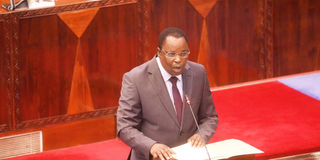
Chairperson of the Parliamentary Standing Committee on Budget, Mashimba Ndaki, speaking while presenting the National Development Plan for the 2026/2027 financial year in Parliament Dodoma City. PHOTO | SAID KHAMIS
Dar es Salaam. Members of Parliament have raised concern over mounting fiscal pressures on the government, warning that a widening financing gap in the Universal Health Insurance (UHI) scheme, rising public debt and weaknesses in project preparation could undermine the sustainability of key national programmes.
Presenting the Budget Committee report during debate on the Sh62.3 trillion 2026/27 national budget on Monday, committee chairman Mr Mashimba Mashauri Ndaki said Tanzania faces structural fiscal challenges that require urgent action to safeguard public finances.
A central concern is the financing gap in the Universal Health Insurance scheme, which requires about Sh691.3 billion annually but currently generates only Sh201.9 billion from existing revenue sources, leaving a shortfall of approximately Sh489.5 billion.
Mr Ndaki told Parliament that while government has established dedicated funding streams for the programme, they remain insufficient to sustain full implementation.
“Existing revenue sources are not sufficient to meet the cost of implementing Universal Health Insurance, leaving a significant financing gap that must be addressed to ensure sustainability of the scheme,” he said.
He recommended that government adopt a phased approach, beginning with households identified in the first phase as a pilot to test financial sustainability before scaling up nationwide coverage.
According to the committee, the scheme is expected to cover about 3.9 million vulnerable households, equivalent to 26.4 percent of poor households in mainland Tanzania.
However, only 931,693 households have so far been identified, leaving nearly three million yet to be registered.
Lawmakers noted that the Ministry of Health plans to complete the identification process over three financial years from 2026/27 to 2028/29, with implementation expected to proceed gradually in stages.
Mr Ndaki cautioned that expansion without adequate funding could strain the health system and undermine confidence in the programme.
“Careful sequencing of implementation is necessary to avoid creating expectations that cannot be sustainably financed,” he noted.
Beyond financing challenges in the health sector, MPs also raised concern over structural weaknesses in digital health systems, pointing out that more than 15 separate platforms currently operate independently without interoperability. The committee warned that fragmentation of health
information systems could undermine efficiency and coordination, calling for urgent integration into a single national framework.
Lawmakers urged government to establish a unified Universal Health Insurance data system linking primary healthcare facilities to referral hospitals in order to improve service delivery and accountability.
Rising debt
On public debt, the committee reported that national debt stood at Sh114.34 trillion as of March 2026, representing an increase of 8.97 percent compared to the previous year. External debt accounts for 66.4 percent, while domestic debt makes up 33.6 percent.
The debt-to-GDP ratio has risen to 48.8 percent, still within the statutory ceiling of 55 percent, but MPs warned that the margin of safety is narrowing.
Mr Ndaki said while debt remains broadly sustainable, key indicators are approaching risk thresholds, requiring more disciplined borrowing.
“While debt is still sustainable, we are approaching levels where any additional pressure could reduce fiscal flexibility,” he told Parliament.
The committee further revealed that about Sh14 trillion will be allocated to debt servicing in the current financial year, a burden MPs said is crowding out development spending.
Lawmakers also criticised weaknesses in project preparation, saying inadequate feasibility studies continue to drive cost overruns and additional borrowing requirements.
They cited major infrastructure projects, including the Selander Bridge project, which required an additional $32.62 million, representing a 36 percent increase, and the Kigoma–Nyakanazi power substation, which needed an extra $25.5 million, a 57 percent increase.
“These overruns are a clear indication that some projects are not adequately prepared before implementation, leading to unnecessary escalation of costs,” Mr Ndaki said.
The committee also raised concern over the use of borrowed funds for recurrent expenditure, noting that part of the Sh4.5 trillion received under the Programme-for-Results arrangement was used to finance routine government operations instead of development projects.
“This practice weakens the original intent of development financing and reduces the impact of borrowed funds on growth and service delivery,” he said.
MPs warned that debt service indicators are edging closer to statutory thresholds, with debt repayments projected at 12.2 percent of export earnings against a 15 percent ceiling, and 13.8 percent of government revenue against an 18 percent threshold.
Kikwajuni MP Ali King said poor preparation of projects continues to drive inefficiencies and unnecessary borrowing.
“Many development projects are initiated without adequate preparation, which increases implementation costs and forces the government to borrow more. Strengthening project appraisal would ensure loans deliver real value to citizens,” he said.
MP Nancy Nyalusi called for stricter fiscal discipline, urging government to cut non-essential expenditure, including the cost of official vehicles and other administrative spending.
“The aim is to reduce unnecessary expenditure so that we can ease pressure on public debt. Weak project preparation is also creating avoidable financial strain,” she said.
She further warned that some infrastructure assets are already deteriorating before completion of maintenance grace periods, raising concerns over value for money in public investments.
The Budget Committee also urged stronger domestic revenue mobilisation and tighter control over borrowing to protect fiscal stability in the medium term.
The Parliament has seven days to debate and approve the budget before it is enacted into law under the Finance Act.
Register to begin your journey to our premium contentSubscribe for full access to premium content